Carrier Safety & Awareness
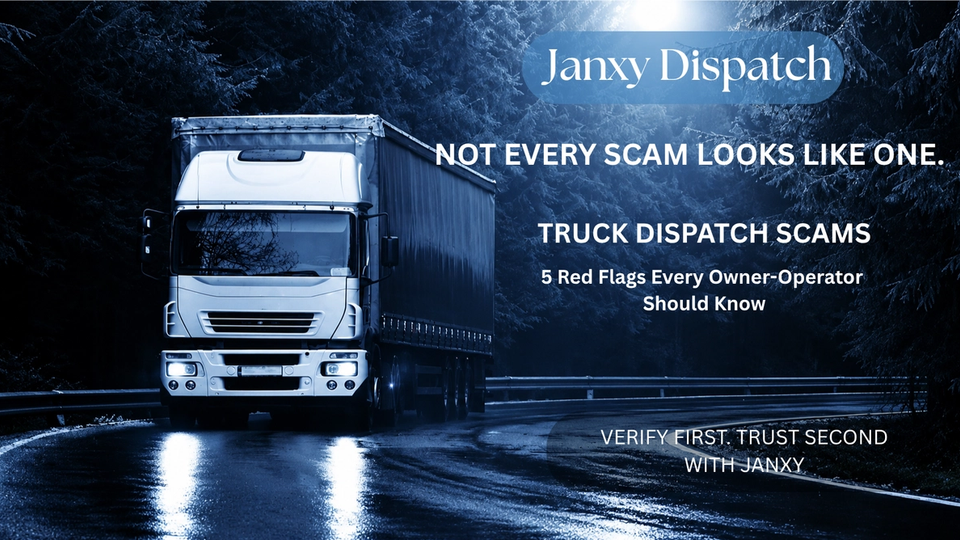
Truck Dispatch Scams: 5 Red Flags Every Owner-Operator Should Know
Learn 5 warning signs of truck dispatch scams and how owner-operators can verify offers, avoid suspicious fees, and protect their hard-earned money.
Truck Dispatch Scams: 5 Red Flags Every Owner-Operator Should Know
A dispatcher sends you a load that looks almost too good to pass up.
Great rate. Good lane. Everything looks legitimate.
Then comes the catch.
There's suddenly a problem with your safety status. Or an inspection you supposedly need. Or a compliance service that has to be paid for right now before anything can move forward.
You came looking for freight.
Now somebody is asking you for money.
That is exactly why truck dispatch scams can be dangerous: they don't always look like scams at first.
For an owner-operator, every dollar already has a job. Fuel needs to be paid for. Insurance is due. Maintenance never really stops. Then there are truck payments, tolls, repairs, and everything else that comes with keeping a truck on the road.
Losing even a few hundred dollars to a trucking scam can hurt.
At Janxy Dispatch, this issue is personal to us.
Before building Janxy Dispatch, our co-founders had firsthand experience working inside the truck dispatch industry. What they saw helped shape the kind of dispatch company they wanted Janxy to become. You can read about us at Janxy Dispatch About
When a Great Load Is Only Bait
During their time in the industry, our co-founders came across practices that didn't sit right with them.
A carrier could be approached with an attractive load opportunity. The lane looked good. The rate got their attention. Everything appeared to be moving in the right direction.
Then the conversation changed.
Suddenly there might be a supposed problem with the carrier's safety status. Or money might be requested for an inspection, documentation, activation, compliance service, or some other requirement that supposedly had to be completed before moving forward.
The carrier came looking for freight.
Instead, the conversation became about getting money from the carrier.
Experiences like these helped establish one of the principles behind Janxy Dispatch:
A dispatcher should make money when the carrier makes money — not by inventing reasons to take money from the carrier.
And this problem extends beyond dispatch companies.
FMCSA currently warns motor carriers about phishing attempts, fake audits, fraudulent compliance notices, SAFER impersonation, fake government documents, and other schemes designed to obtain sensitive information or money. You can check it out at FMSCA-Fraud Alerts.
That's why knowing the warning signs of trucking fraud and truck dispatch scams matters.
Why Truck Dispatch Scams Can Be So Convincing in 2026-27
Not every scammer sounds like a scammer.
That's part of the problem.
A fraudulent email can look professional. A fake document can carry official-looking branding. Someone can understand trucking terminology, know how carriers operate, and still be trying to take advantage of an owner-operator.
FMCSA has warned that phishing attempts targeting motor carriers can include professional-looking documents and links designed to resemble legitimate government communications. FMCSA-Recent Phishing Scheme
So an offer shouldn't be trusted simply because it looks professional.
For owner-operators, there's a simple principle worth remembering:
If an unbelievable opportunity is being used to pressure you into sending money, slow the conversation down.
A legitimate opportunity should survive a few questions.
And before you trust an unfamiliar dispatcher, broker, freight service, or compliance request, watch for these five red flags.
5 Truck Dispatch Scam Red Flags Every Owner-Operator Should Watch
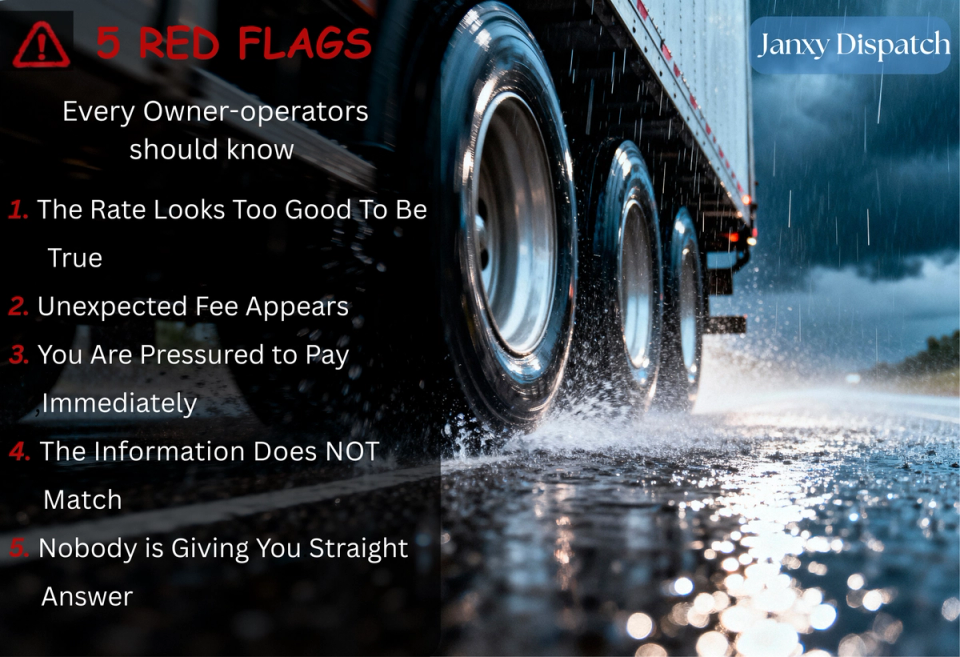
1. Unexpected Fees Suddenly Appear
This is one of the biggest dispatch scam warning signs to pay attention to.
You were contacted about freight.
Then, somewhere along the way, you're suddenly being asked to pay for something else.
Maybe it's described as an inspection.
A compliance document.
An activation.
A safety service.
A registration problem.
Or another requirement that supposedly needs to be handled before the load can move forward.
An unexpected fee does not automatically mean you're dealing with fraud. But it does mean you should understand exactly what you're paying for before sending money.
Ask:
- What exactly am I paying for?
- Who is receiving the money?
- Why is this required?
- Can I independently verify the requirement?
- Can I confirm it through an official source rather than a link provided by the person asking for payment?
That's especially important when somebody claims to represent a government agency. FMCSA says it will not request payment or sensitive information such as a PIN, SSN, EIN, or banking details through unsolicited messages. FMCSA-Recent Phishing Scheme
A professional-looking invoice, email, or document is not a substitute for verification.
2. You're Pressured to Pay Immediately
Pressure works because it reduces the amount of time you have to think.
You might hear:
“You need to do this right now.”
“The load will disappear.”
“There's a problem with your account.”
“The payment has to be made before we can continue.”
Urgency alone does not prove that something is a truck dispatch scam.
Trucking moves quickly. Loads disappear. Decisions sometimes genuinely need to be made fast.
But when urgency is combined with an unexpected payment request, unusually attractive load, suspicious document, or information you cannot independently verify, stop and investigate.
Don't allow fear of losing one load to put your business at risk.
A legitimate opportunity can survive a few minutes of verification.
3. The Information Doesn't Match
This is where a little detective work can save an owner-operator a lot of trouble.
A logo doesn't prove a document is genuine.
A professional email signature doesn't prove the sender represents the company they claim to represent.
And something that resembles an FMCSA document isn't automatically an official government notice.
Check the details independently.
Look at the company name, phone number, email domain, website, USDOT information, MC information, and other identifying details.
FMCSA's SAFER Company Snapshot allows users to search using a company name, USDOT number, or MC/MX number and review identifying and safety information. FMCSA SAFER - Company Snapshot
And don't assume that the first phone number or website you find through a search engine is automatically legitimate. FMCSA warns that scammers can create fake profiles and recommends confirming information through multiple sources.
One important distinction:
A Gmail, Yahoo, or other generic email address is not automatically evidence of a trucking scam.
Plenty of legitimate small businesses use free email providers.
But when an unfamiliar person is asking for money, sensitive information, or access to your business, independently confirming who you're dealing with becomes much more important.
4. The Rate Looks Too Good to Be True
A strong freight rate is not automatically suspicious.
Good loads exist.
But when a load pays far beyond what similar freight is paying in the same market — particularly when it's paired with pressure to book immediately — it's worth taking a closer look.
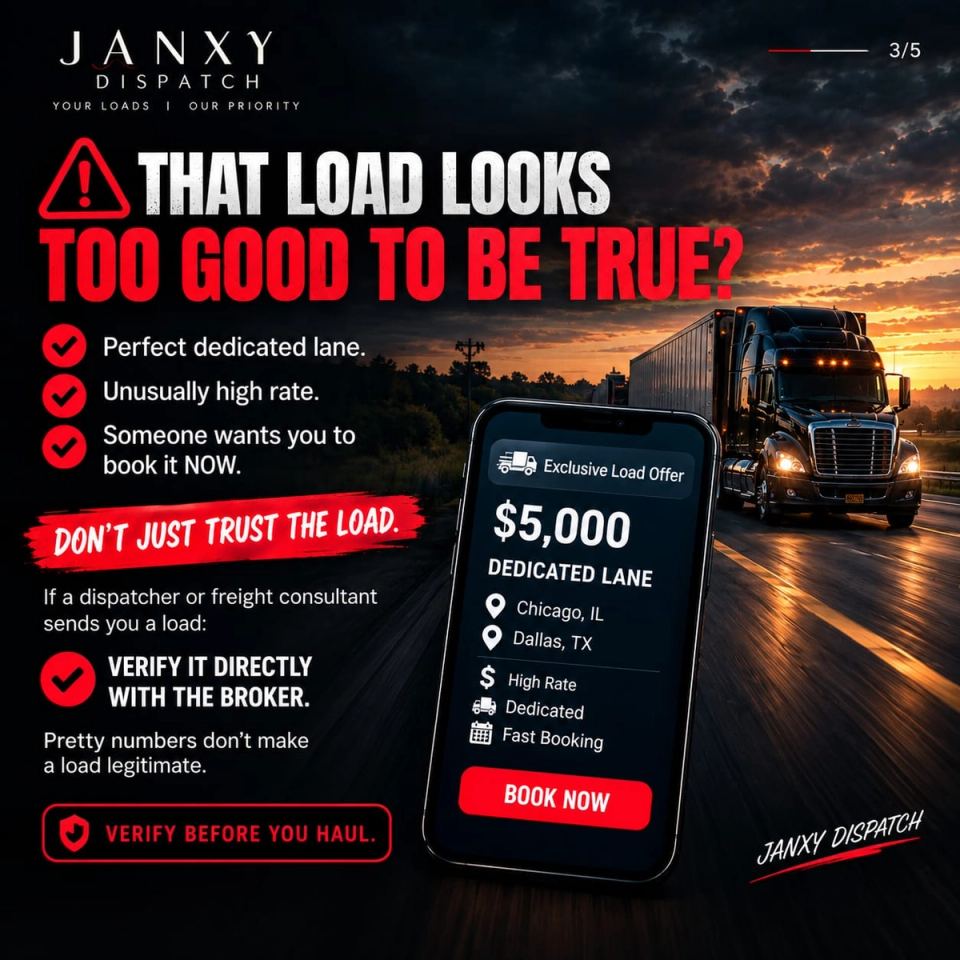
FMCSA's broker and carrier fraud guidance lists a rate that far exceeds the current market rate as one reason to stop and verify a transaction.
Scammers understand what gets a carrier's attention.
A great lane.
An unusually high rate.
A supposedly limited opportunity.
And sometimes the number is attractive precisely because you're supposed to act before you have time to question it.
Don't let urgency replace verification.
Before acting on a suspiciously attractive load, independently confirm who you're dealing with and whether the opportunity is legitimate.
5. Nobody Will Give You a Straight Answer
Owner-operators have every right to ask questions before sending money, signing a dispatch agreement, or trusting someone with part of their business.
If you ask what a charge is for, you should receive a clear explanation.
If someone says a requirement is mandatory, you should be able to verify that claim.
If you're told there's a problem with your MC or DOT information, you should be able to investigate it independently.
And if simple questions repeatedly lead to changing stories, vague explanations, complicated excuses, or more pressure to pay?
Take that seriously.
Legitimate businesses should be able to explain what they're selling, what it costs, and why you're being charged for it.
The Solution: Verify Before You Trust
You don't need to distrust every dispatcher, broker, or trucking service you encounter.
You need a verification habit.
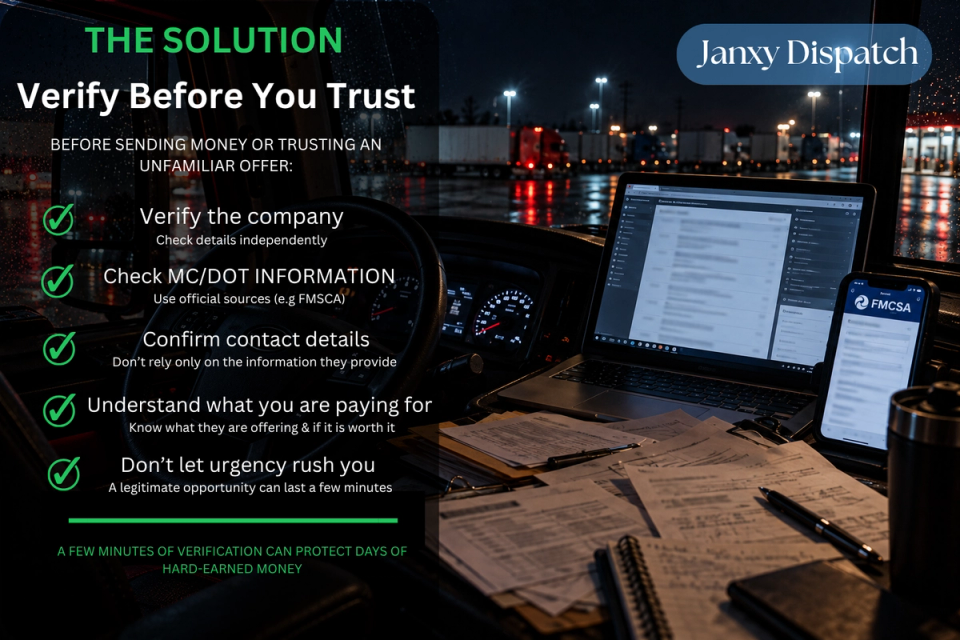
Before trusting an unfamiliar trucking service:
Verify the company.
Check important business details independently rather than relying entirely on what the person contacting you provides.
Check MC/DOT information.
Use official sources when appropriate. FMCSA's SAFER Company Snapshot is one resource for checking company identification and safety information. FMCSA SAFER - Company Snapshot
Confirm contact details.
Make sure the person you're speaking with actually represents the company they claim to represent.
Understand what you're paying for.
Know what the service is, who receives the payment, and why the payment is required.
Don't let urgency rush you.
If something feels wrong, give yourself enough time to check it.
Keep copies of important conversations, agreements, and documents as well.
And never share sensitive business information simply because somebody sounds professional on the phone.
A few minutes of verification can protect money that took days on the road to earn.
What to Do If You Suspect a Trucking Scam
If you receive a suspicious message claiming to come from FMCSA, avoid clicking unfamiliar links or providing sensitive information until you've independently confirmed the communication.
FMCSA advises targets of fraud or suspicious communications that they can contact the FMCSA Contact Center and identifies reporting options including the Federal Trade Commission, FBI Internet Crime Complaint Center, USDOT Office of Inspector General, and FMCSA National Consumer Complaint Database. FMCSA — Broker and Carrier Fraud and Identity Theft
For suspicious broker or carrier activity, save the evidence you have — emails, phone numbers, documents, payment requests, and other communications — rather than deleting everything immediately.
Where Janxy Dispatch Stands
The firsthand experiences of our co-founders helped shape a simple belief at Janxy Dispatch:
The relationship between a carrier and dispatcher should be transparent.
We don't believe in attracting owner-operators with imaginary promises and then looking for another way to make money from them.
Our dispatch fee is tied to the freight we dispatch.
Carriers should know what we charge, what we do, and what to expect before working with us.
No mystery.
No manufactured problem just to sell a solution.
No “too good to be true” load used as bait.
Our goal is straightforward: build long-term working relationships with owner-operators by helping keep their trucks moving and making the dispatch process easier to manage.
[Explore Janxy Dispatch Services → Janxy Dispatch Services]
Because behind every truck is a business.
And behind that business is a person who worked for what they have.
Protect What You Worked For
Truck dispatch scams, owner-operator scams, and freight fraud continue to change.
The answer isn't to distrust everyone in trucking.
It's to verify before you trust.
Ask questions.
Check credentials.
Investigate unusual requests.
Understand what you're paying for.
And don't allow pressure to make an important business decision for you.
No load is worth risking your business over.
You already did the hard part:
You earned it.
Protect your truck. Protect your business. Protect what you worked for.
If you're looking for a legitimate truck dispatch service built around transparent pricing, clear expectations, and carrier-focused service, Janxy Dispatch is here to talk.
[Talk to Janxy Dispatch → Contact]
— Janxy Dispatch