Janxy Dispatch
How Janxy Dispatch Works: A Step-by-Step Guide for Owner-Operators
See how Janxy Dispatch works from onboarding to delivery, including load searching, broker communication, rate negotiation, carrier approval, coordination, and paperwork—all while keeping the carrier in control.
How Janxy Dispatch Works: A Step-by-Step Guide for Owner-Operators
Running a truck means making decisions all day. Between driving, watching the clock, communicating with brokers, checking load details, planning the next move, and organizing paperwork, the administrative side of the business can take attention away from the road.
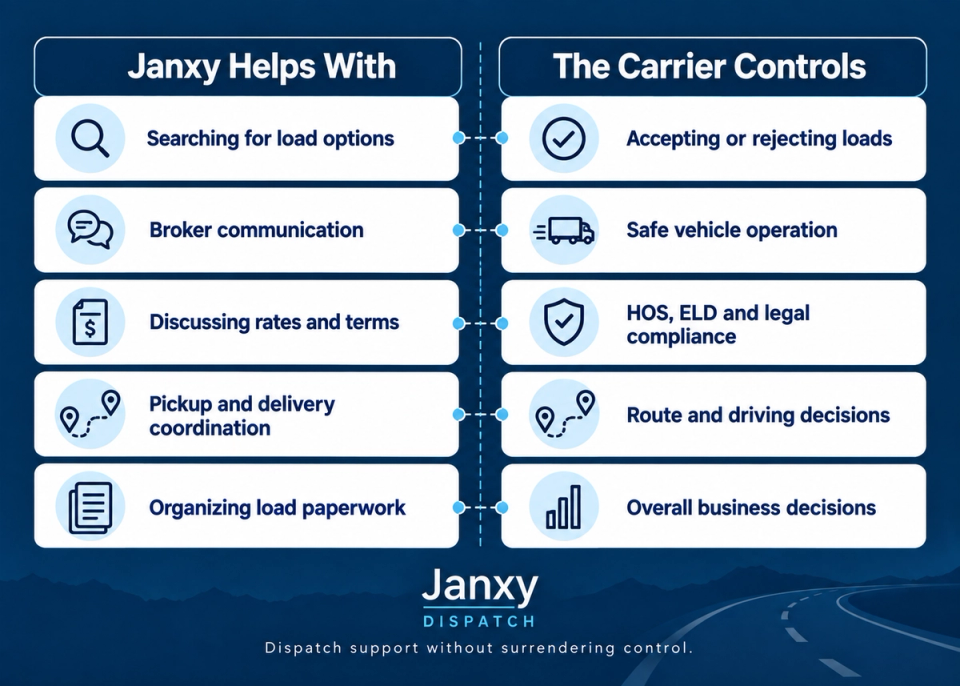
Janxy Dispatch is built to support owner-operators and small carriers with that day-to-day dispatch work. We help search for suitable load options, communicate with brokers, discuss rates and terms, coordinate load details, and organize dispatch paperwork. You remain in control of your truck, your schedule, and every load you accept.
So, what actually happens after you contact us? Here is the Janxy Dispatch process from the first conversation through delivery.
What Is Janxy Dispatch?
Janxy Dispatch provides contracted dispatch support to motor carriers. We work on the carrier's side of the transaction and perform services according to a written agreement. We do not operate as a freight broker, take possession of freight, or accept a shipment first and then search for an available carrier.
That distinction depends on conduct, not simply on the name a company uses. In its final guidance on brokers, bona fide agents, and dispatch services, the Federal Motor Carrier Safety Administration explains that a dispatch service's status depends on the nature and scope of its actual activities. Relevant factors include whether the dispatcher has a written agreement with the carrier, works through brokers rather than soliciting shippers, is paid by the carrier, stays outside the freight-payment transaction, and arranges a shipment for the specific carrier it represents.
Our operating principle is simple: we provide support around the movement while you remain in control of the decision. Our goal is to help you move with confidence.
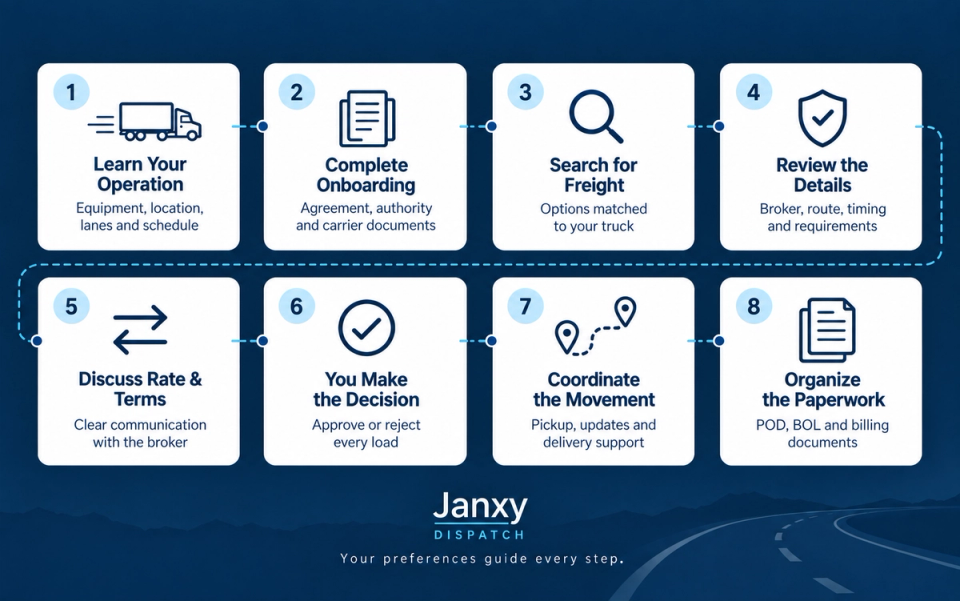
Step 1: We Learn How You Want to Run Your Truck
The process begins with a conversation, not a random load search. We ask about your operation so that the search can be built around the way you actually work. A load that looks attractive on a board may be a poor fit once deadhead, appointment times, equipment requirements, home time, or the destination are considered.
During the first conversation, we discuss details such as:
- Your equipment type, dimensions, capacity, and any special limitations
- Your current location and availability
- Preferred lanes, regions, and states
- Areas you do not want to enter
- Home-time and scheduling preferences
- Your expected rate per mile and operating priorities
- Whether you use a factoring company
- Any broker, facility, commodity, or route restrictions you want us to follow
These preferences form your carrier profile. They are not permanent rules unless you want them to be. If your priorities change because of weather, maintenance, home time, market conditions, or another business need, the search can change with them.
Step 2: We Complete a Clear Onboarding Process
If we agree that Janxy is a suitable fit for your operation, the next step is formal onboarding. The purpose is to establish who we represent, define the services we may perform, and make sure the information commonly needed for broker setup is organized before load opportunities begin moving quickly.
Depending on your business and payment setup, the onboarding file may include:
- A completed carrier profile
- Your USDOT and MC authority information
- A current certificate of insurance
- A completed Form W-9 supplied by the carrier
- A written dispatch service agreement
- A limited power of attorney, when included in the agreed service arrangement
- A notice of assignment or other factoring information, when applicable
The dispatch agreement defines the relationship, service scope, fee, responsibilities, and limits of authority. Any limited power of attorney used for dispatching should be restricted to the specific functions stated in the document. It should not give a dispatcher ownership of the carrier's equipment, unrestricted access to bank accounts, or authority to create unrelated debt.
Form W-9 should be completed according to the carrier's actual tax classification. The IRS instructions for Form W-9 explain that the name and taxpayer identification number must match the applicable tax record and provide separate instructions for disregarded entities. Janxy may organize the document for carrier packets, but the carrier is responsible for providing accurate tax information and should consult a qualified tax professional when uncertain.
Sensitive documents are not requested through the public contact form. Initial inquiries should contain only the basic information needed to discuss fit and schedule a conversation.
Step 3: We Search for Freight Around Your Operation
Once onboarding is complete and your truck is available, we search for load options based on the profile and instructions connected to that specific truck. The goal is not to grab the first load that appears. It is to narrow the market to options that make practical sense for your equipment, location, schedule, and stated preferences.
We consider the pickup location, deadhead, loaded miles, destination, appointment requirements, commodity, weight, equipment requirements, and the information you have given us about your availability. Market conditions can change quickly, so no dispatcher can guarantee a particular rate, load volume, or level of revenue. What we can provide is an organized search and a consistent process for evaluating the options that are available.
Janxy does not accept freight without an identified carrier and then shop that shipment to a pool of trucks. A search conducted for your truck is handled for your operation under your agreement and instructions.
Step 4: We Review the Broker and the Load Details
A rate alone is not enough to evaluate a load. Before recommending an option, we review the available information about the broker and ask for the details needed to understand the movement.
Broker screening may include checking public information through FMCSA's SAFER Company Snapshot and Licensing and Insurance system, comparing the contact information being used with known company information, reviewing authority details, and checking other business records or tools available to the carrier. Screening can reduce avoidable risk, but it cannot guarantee that a transaction will be free from fraud, disputes, nonpayment, or identity theft.
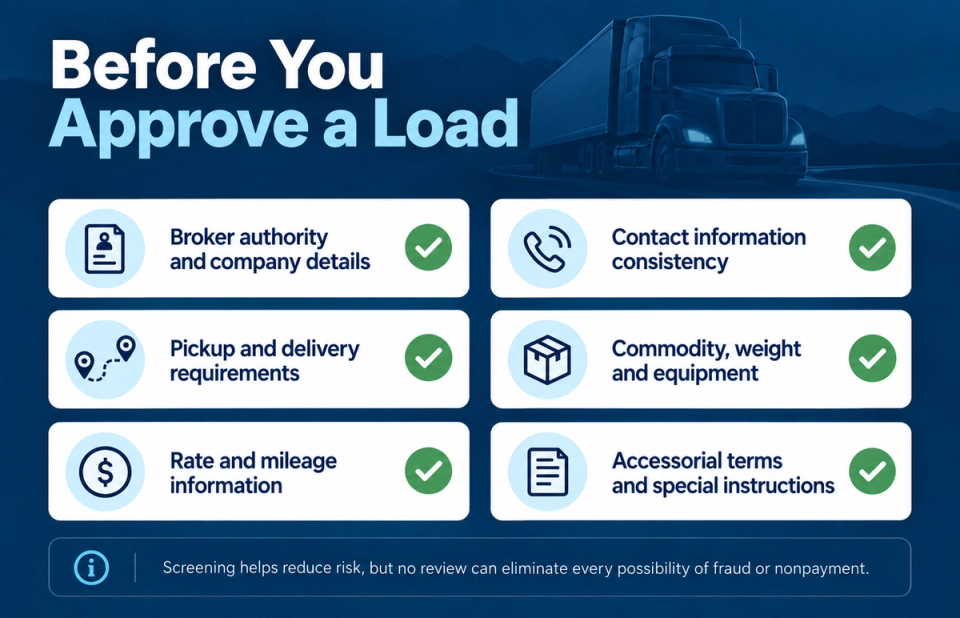
We also confirm the practical terms of the load. Depending on the shipment, that may include pickup and delivery times, commodity, weight, required equipment, stops, tracking requirements, special instructions, and the broker's policies for detention, layover, truck ordered not used, lumper reimbursement, or other accessorials.
If important information is missing or inconsistent, we ask questions before asking you to make a decision.
Step 5: We Discuss the Rate and Terms With the Broker
When an option fits your truck, Janxy communicates with the broker about the rate and relevant terms. Negotiation is not only about asking for a higher number. The total movement must be considered, including deadhead, loaded miles, time, location, appointments, operating preferences, and any special requirements that could affect the truck.
Our role is to advocate for the carrier and seek the best reasonable terms available for the specific opportunity. However, the final rate depends on the market, the broker, the shipment, capacity, timing, and the carrier's own decision. We do not promise a minimum rate per mile, a fixed weekly gross, or guaranteed profitability.
Step 6: You Review the Load and Make the Final Decision
Before a load is booked, we present the important information to you in a clear format. This normally includes:
- The broker's name
- The gross rate
- Loaded miles and estimated deadhead
- The approximate rate per mile based on the mileage information available
- Pickup and delivery locations
- Appointment dates and times
- Commodity, weight, and equipment requirements
- Stops, special instructions, or tracking requirements
- Relevant accessorial terms discussed with the broker
You can accept or reject the option. If it does not fit your goals, schedule, comfort level, or operating plan, you can say no. Janxy does not force loads, penalize a carrier for declining an option, or make the final load decision on the carrier's behalf.
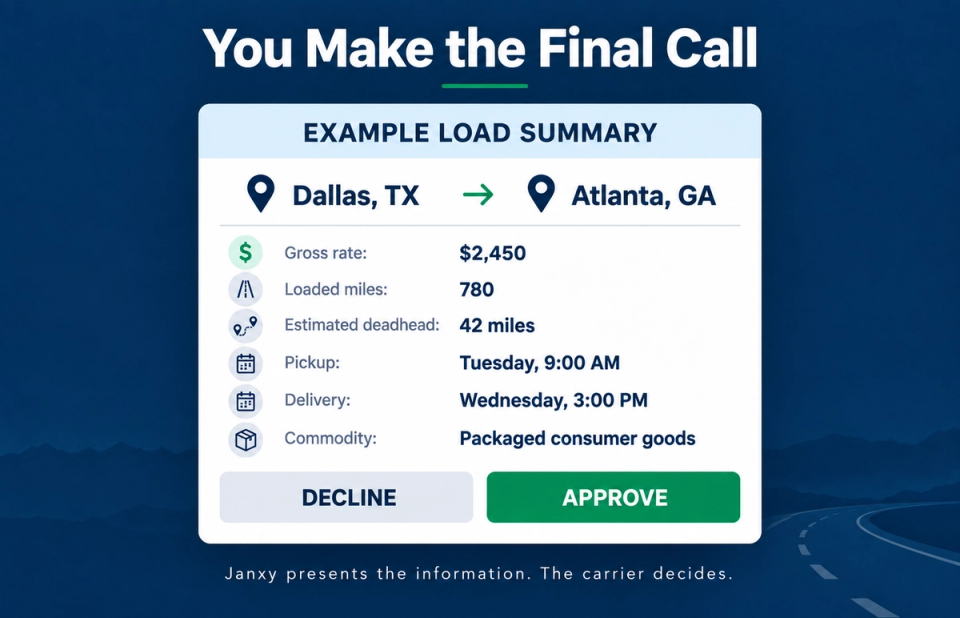
No rate confirmation should be accepted or signed on your behalf without your approval and without authority granted in the written agreement. Carrier control is not a slogan added after the process. It is part of the process itself.
Step 7: We Help Coordinate the Load From Pickup to Delivery
After you approve the load, Janxy helps organize the dispatch side of the movement. This may include completing or coordinating the carrier packet, reviewing the rate confirmation with you, confirming appointment information, sharing dispatch details, communicating updates requested by the broker, and helping keep the parties informed when circumstances change.
We also plan communication around the availability and Hours of Service information you provide. The carrier and driver remain responsible for safe and lawful operation, accurate logs, route decisions, vehicle condition, cargo securement, and compliance with applicable regulations. FMCSA's summary of Hours of Service regulations is a useful official reference, but it does not replace the regulations or professional compliance advice.
If a delay, detention event, layover, rejected product, or other issue occurs, we can help document the situation and communicate with the broker. Approval and payment of accessorial charges depend on the rate confirmation, supporting records, applicable terms, and the broker's decision. Janxy cannot guarantee that a broker will approve or pay a request.
Step 8: We Organize Delivery Paperwork and the Next Move
Once the load is delivered, prompt and accurate paperwork helps reduce preventable billing delays. We follow up for the signed proof of delivery or bill of lading and help organize other relevant records, such as lumper receipts, rate confirmations, and supporting documents connected to approved accessorial requests.
If you use a factoring company, we can help coordinate the required load documents according to the process established by you and the factor. If you bill brokers directly, we can help organize the paperwork for your invoicing process. Freight payment remains between the carrier and the broker or factoring company. Janxy does not receive the broker's freight payment or take a share from the broker or factor.
After the documents are organized, we update the search around your new location and availability. The next move begins with the same principle as the first one: your instructions guide the work.
What Janxy Dispatch Does Not Do
Trust becomes easier when the limits are stated as clearly as the services. Janxy Dispatch does not:
- Force you to accept a load
- Guarantee rates, revenue, load volume, or profit
- Take possession of freight or operate your equipment
- Accept a shipment before a specific carrier is identified
- Reassign a load sourced for one client carrier to another client carrier
- Solicit shippers or present itself as a freight broker
- Receive freight payment from brokers or factoring companies
- Control your ELD, falsify logs, or instruct a driver to violate safety rules
- Replace legal, tax, insurance, safety, or regulatory professionals
These boundaries protect the carrier's control and help keep the relationship focused on legitimate dispatch support.
Is Janxy Dispatch the Right Fit for Your Truck?
Janxy is designed for owner-operators and small carriers who want help with load searching, broker communication, negotiation, coordination, and paperwork without handing away control of the business. The best working relationships are built on clear instructions, realistic expectations, timely communication, and honest decisions about which loads do or do not fit.
Our current main support covers dry vans, reefers, box trucks, and sprinter vans. We are also expanding our support for flatbeds, hotshots, and other equipment types. If you operate different equipment, contact us to discuss your operation at janxy dispatch contact and we’ll do our best to accommodate your needs.
Start With a One-Week Free Trial
Janxy Dispatch offers a one-week free trial so you can experience the workflow before deciding whether to continue. Before the trial begins, we discuss the service scope, operating preferences, documents, communication process, and the pricing that would apply if you choose to continue after the trial. The trial does not guarantee loads, rates, revenue, or broker approval.
Ready to discuss your truck? Contact Janxy Dispatch, call or WhatsApp (307) 303-3098, or email dispatch@janxydispatch.com. You can also review our dispatch services and pricing before scheduling a conversation.
Frequently Asked Questions
Does Janxy choose which loads I have to take?
No. Janxy searches for and discusses load options, but you make the final decision. You may accept or decline any option presented to you.
Is Janxy Dispatch a freight broker?
No. Janxy is designed to provide dispatch support under an agreement with the motor carrier. We do not solicit shippers, accept freight without an identified carrier, take possession of cargo, or receive the carrier's freight payment. Because FMCSA evaluates status based on actual activities, our operating process and agreements must remain consistent with those boundaries.
What documents are needed to get started?
The exact requirements depend on the carrier and payment setup, but onboarding commonly includes a carrier profile, MC and USDOT information, certificate of insurance, Form W-9, dispatch agreement, limited power of attorney where applicable, and factoring or payment-assignment information where applicable.
Can Janxy guarantee a certain rate per mile or weekly gross?
No. Rates and load availability change with lane, equipment, location, season, timing, capacity, and broader market conditions. We can search, communicate, negotiate, and provide information, but we cannot guarantee a result that depends on the freight market and third parties.
Who pays Janxy, and who receives the freight payment?
The carrier pays Janxy according to the written dispatch service agreement. The broker or factoring company pays the carrier according to the relevant transportation and payment arrangements. Janxy does not receive the broker's freight payment.